
How to Read a Court Case Efficiently: A Beginner’s Guide for Law Students

Entering law school comes with a massive shift in reading habits. Suddenly, you're handed 50-page court judgments filled with dense legal prose, Latin maxims, and complex references. Trying to read a judgment word-for-word like a novel is the fastest path to burnout.
To survive and excel, you need a strategy. Here is a simple, step-by-step breakdown to help you read court cases efficiently for Law Students.
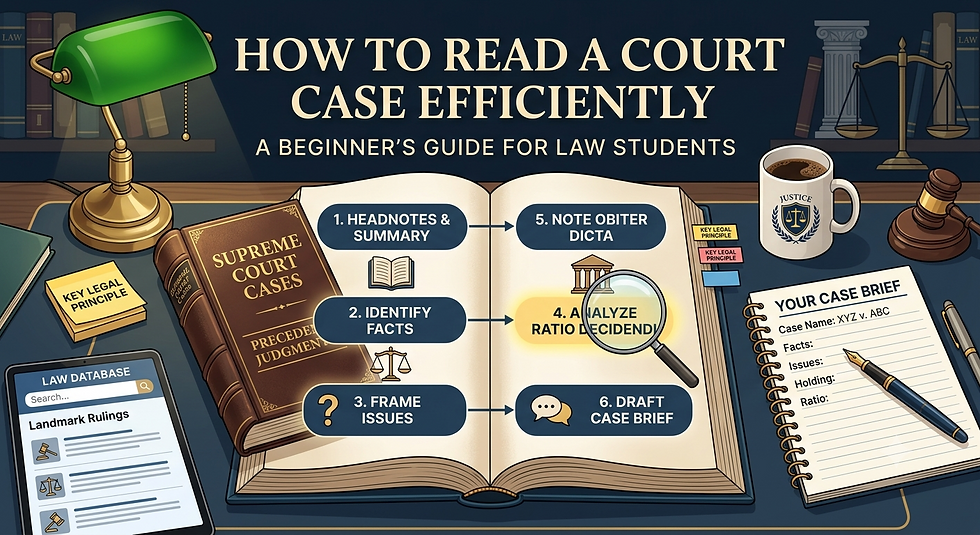
1. Start with the Headnotes & Summary
Before diving into the full judgment, read the headnotes, syllabus, or editor’s summary provided in legal databases (like SCC Online or Manupatra). This gives you a quick map of the case so you know where the argument is heading.
2. Identify the Core Components (The FIRAC Structure)
When analyzing the text, break your reading into five key elements:
Facts: What happened between the parties? Focus only on material facts that led to the dispute.
Issue: What specific legal question is the court being asked to decide?
Rule: Which laws, statutory provisions, or precedents apply here?
Analysis (Ratio Decidendi): Why did the judges decide the way they did? This is the core legal reasoning you must highlight.
Conclusion: What was the final order or holding?
3. Separate Ratio Decidendi from Obiter Dicta
Not every sentence in a judgment creates a binding rule:
Ratio Decidendi: The core rationale integral to the final decision. This forms the binding legal precedent.
Obiter Dicta: Casual observations, passing remarks, or hypothetical illustrations made by the judge. Useful for discussion, but not legally binding.
4. Read to Brief, Not Just to Finish
Always read with a pen or note-taking tool active. Immediately summarize the case into a 1-page Case Brief containing:
Case Name & Citation
Bench Strength & Year
Key Facts (3–4 bullet points)
Issues Raised
Holding & Ratio
Final Tip: Don't stress if a complex judgment takes time on your first attempt. Case reading is a muscle—the more structured your approach, the faster you get!

Comments